Treatments — Skin
Scar Revision
Scar Revision by Mr. BanwellDo you have a scar that you do not like? Perhaps you had issues with delayed healing or infection following previous surgery?
Treatments — Skin
Do you have a scar that you do not like? Perhaps you had issues with delayed healing or infection following previous surgery?
Mr. Banwell has had a particular interest in scarring and wound healing throughout his professional career as a Plastic Surgeon (his work in wound healing and scarring was rewarded with a Visiting Professorship at Harvard no less!) and thus is well placed to see if he can help you.
If you are potentially interested in a scar revision please feel free to phone the office to book a consultation and Mr. Banwell would be delighted to give an honest and open opinion on the best way forward, medical treatment options and the suitability for potential surgical revision.
The commonest scar revision we perform is for caesarian section scars; these can be revised easily but if you have an overhang of skin as well or a so-called ‘pouch’ then you would probably require a mini tummy tuck. However, we are also able to assess and treat any problematic, ugly or painful or itchy scars.
"As a world expert in scars and wound healing Mr Banwell is well placed to offer advice on scar revision."
SURGERY TIME
30 - 60 Minutes
HOSPITAL STAY
Out-patients
ANAESTHETIC ASSESSMENT
No
PRE ADMISSION TESTS
No
SLEEPING POSITION
Sleeping on back recommended
REASONABLY MOBILE
Immediately
WASHING
Shower after 1 day
DRIVING
Immediate
EXERCISE INCLUDING GYM
2 weeks
SEXUAL ACTIVITY
Restricted Activity
FULL RECOVERY
Immeidate
TIME OFF WORK
None
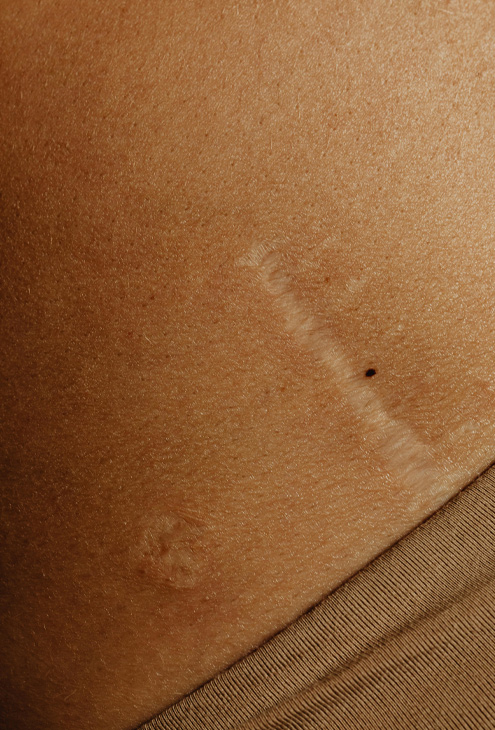
Many patients do not realise that scar take 18 months to 23 years to settle. Initially scars are red and then they fade over time. Regular massage to scars in the post-operative phase twice a day with a moisturising cream doesn’t sound glamorous or technical but it is fundamental to scar maturation and scar outcome. Any moisturising cream will do; bio-Oil is OK but only after 4 weeks. Advertised silicone scar gels are expensive and do not do anything but silicone gel sheeting may be useful where scars become unusually red and raised (so called hypertrophic scars).
The majority of scars will settle over time as a thin white line but please be patient with this process. If scars do not settle as we would hope and you are seeking scar advice Dr Paul can recommend a variety of other scar treatments including steroid injections, silicone gel sheeting, skin boosters with hyaluronic acid and amino acids and CO2 lasering.
Useful downloadable materials tailored to this procedure.
The decision for cosmetic surgery should not be taken lightly. This is why Mr Banwell believes that the consultation process with him and our Concierge is so important. Regardless we are here to hold your hand throughout your journey and answer any questions you may have. That leap of faith may be anxiety-provoking but please know that we will always be here to catch you!
It is completely NORMAL for scars to look red and lumpy after any operation. Initially, for the first couple of weeks, the scar(s) may look excellent. However, they will then become red and lumpy. This is a normal response to wound healing. Over time these scars will mature and the scars will soften, become flatter and paler. This process takes around 18 months to 2 years and may require revisions.
Specialist surgeons like Mr Banwell will always tape your scar line for the first 2 weeks after surgery. Usually this will be with brown micropore tape [this is showerproof and will stay in place as long as it is dried with a hairdryer each time it gets wet]. Ideally the scar should be taped for an additional few weeks to protect and support it.
After this time, Mr Banwell recommends a twice daily massage with a moisturizing cream (eg. Vitamin E). Do not use E45 as it is too thick and claggy!! This should continue for at least 3-6 months and ideally up to a year. The purpose of this is to speed up the natural healing and repair process and allow the scars to soften, flatten and become paler.
Absolutely!!! If immature scars (within the first year) are exposed to the sun they can become pigmented or stay red permanently. It is therefore important to cover scars with clothing or sun protection factors (SPF50) to optimize scar outcome.
Moisturisers and massage are by far the best treatment for scars but additional treatments such as silicone gel sheeting (eg. Cica-care gel) or silicone gel applications (eg. Dermatix or Kelo-cote] may also be beneficial. However, there is NO evidence for the benefit of Bio-oil but many people do use this.
Early problems following surgery include infection, bleeding and the wound pulling apart (dehiscence). Adverse scarring can also occur such as hypertrophy and keloid scarring (see below), Hypersensitivity of scars can also be a problem (this is usually due to not enough massaging in the early post-operative period).
Hypertrophic scars are red (pink) lumpy scars that continue to grow, after the original wound has healed.
We do not completely understand why hypertrophic scars arise, and there is a lot of research being undertaken to further our knowledge. It seems as if the body does not switch off the scar forming mechanism after a wound has healed, and scar tissue continues to be produced, forming a lumpy scar. This is more likely if been a delay in your wound healing, such as after an infection, or when the wound has pulled apart and has been left to heal naturally. Some areas of the body are more prone to them such as the chest and the shoulders.
Keloid scars are lumpy scars that continue to grow, long after the original wound has healed (like hypertrophic scars]. The main difference is that they continue to grow outside of the original area of surgery/injury and may be quite sizeable.
Like hypertrophic scars, we do not completely understand why keloid scars arise. Keloid scars are common in Afro-Caribbean people and also people from the Far East. They are also seen in those with pale skin and red hair. Keloids are difficult to treat – there is no known cure for them.
Hypertrophic and keloid scars can be difficult to treat. Surgery to remove the scar and re-stitch the wound may be considered in certain circumstances. This tends to be when the original wound had healing problems due to an infection – if the wound can be re-stitched and heal the second time around without an infection, it is less likely to become hypertrophic or keloid
Silicone gel – in the form of a sticky gel sheet applied to the scar or alternatively as a liquid from a tube (e.g. Dermatix or Kelo-cote).
Steroid injections – a regular course of injections into the scar itself, repeated every 6-8 weeks (this may also be performed in combination with surgery).
Rarely surgery may be performed in conjunction with radiotherapy treatment for cetain keloid scars.
The success rates of the different treatments is variable, and depends on your individual situation and the reason for having developed the hypertrophic scar.
Once the hypertrophic or keloid scar has improved in terms of size and texture it may not trouble you again. However, in some cases, the hypertrophic scar recurs and further treatment may be necessary.
If the hypertrophic scar comes back, your treatment course may be restarted or another type of treatment may be used.
A variety of different treatments may be use to improve the appearance of scarring (including acne scarring). Commencing a medical grade skin care regime on a daily basis can do wonders for your complexion and the luminosity of your skin but furthermore it can also aid the appearance of scars. Chemical peels, dermaroller, dermastamp or surgical scar revision may also be suitable treatments. Mr Banwell or one of his anaesthetic nurses would be delighted to discuss suitable treatments with you.
Mr. Banwell’s team at the Pantheons Clinic would be delighted to help at any time so please feel free to call HQ on 01342 330302 or email help@paulebanwell.com.


Skin Health & Skin Care
Mr Banwell and his team at The Pantheons Clinic in Sussex, Kent & Harley Street, London are considered international experts in skin health, photoprotection and state of the art skin treatments.

Skin Needling
Genuine Dermaroller therapy is the most advanced and refined medical skin-needling (collagen induction therapy) procedure on the market today.
Lipoma Removal
Fatty lumps under the skin are extremely common and can usually be removed fairly easily.
Mole Removal
Mr Paul Banwell is a Consultant Plastic Surgeon and specialises in mole removal with minimal scarring in the South East and London area.

Skin Cancer Removal
A skin cancer is a ‘growth’ of tissue made up from cancer cells which continue to multiply.
Explore selection of related therapies, which have been carefully chosen to enhance and complement your outcomes.

Before the procedure, would you like to see the new you? With the help of the most popular 3D plastic surgery program in the world, you can now virtually “try on” several breast implants from the comfort of your own home. Don’t forget to save your pictures so you can show them to our surgeon when you visit.
View more reviews on:



Dr Paul founded the award-winning Banwell Clinic 10 years ago and this has become synonymous with innovation and premium care. To commemorate a decade of excellence and expansion of the team we have rebranded the Practice to PANTHEONS Clinic – literally ‘a collection of top experts’ – reflecting our commitment to high quality patient care, patient safety and the drive to make cutting edge technologies available to our ever-growing number of patients.
Disclaimer: Please be aware that these notes have been made for purely information purposes and make no recommendations for surgery.
Download BAAPS Information Sheets



Copyright 2026. Site by Blow Media 
 Back
Back
Breast
 Back
Back
Skin